This article highlights several Japanese terms that have a very precise meaning and usage within the context of legal documents.
Audience Note
It’s assumed that the audience for this article has some basic understanding of Japanese language.
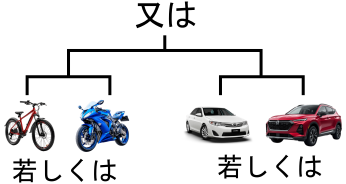
The two words used in formal written documents for listing alternatives, i.e. translating to “or,” are 若しくは and 又は. If there are more than two alternatives a Japanese comma 「、」, called a 読点 is used as a separator.
These two words both translate to “or,” but they have an important and substantive nuance, illustrated in the figure below. 若しくは is used to list alternatives that are similar in some why, while 又は is used to list alternatives from different groups, i.e. are not related.
The distinction seems fastidious, but it comes in extremely handy with some of the lengthy, convoluted statements in laws and orders.
Typically, OR is used to list alternatives within a sentence. However, in some cases, the conditions or alternatives are included as a list. When this happens, it’s common to see a phrase like either (いずれか) in the paragraph that introduces the list of items.
If a list of items or conditions is provided, but a phrase like いずれか is not included in the introducing paragraph, then all the listed elements must be met simultaneously.
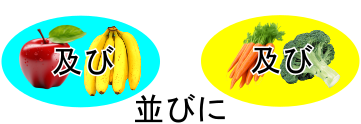
There are several Japanese words that serve as “and”, e.g., と, そして, 及び and 並びに. とand そして are used in spoken Japanese, while the latter two are used in formal written documents.
While both translating to “and” the difference between 及び and 並びに is illustrated in the figure below. 及び is used with related or similar items, while 並びに used with things in different categories.
| Application | Similar Items | Dissimilar Items | Notes |
|---|---|---|---|
| Written | 及び | 並びに | Used in Laws |
| Spoken | と | そして | Not used in Laws |
Closely related to the idea of “and” is “also” (かつ). However, かつ has a special nuance in legal documents: additive requirement.
Important Nuance
When かつ is used, it means “A, and also B,” however the importance nuance is that both A and B conditions must be met.
Like English there are several words like “greater than,” “less than or equal to,” etc., that mark a limit. The Japanese words are extremely important to understand in the context of legal documents.
The following words always attach to the end of the reference word (起算点), to mark it as the limit value.
There are five phrases commonly attached to minimum and maximum limit values.
How to Remember
One easily way to remember the set of words that are “inclusive” (i.e., they include the limit value as well) is that all three start with the character 「以」 which is read “i”, the first letter in “inclusive.”
Similar to the phrases above, there are several words that show ranges in the sense of time or order, rather than amount.
NOTE: Similar to the amount range markers in the previous section, the words above start with the character 「以」 include the marked time phrase, in their range of acceptability.
まで・までに
Somewhat related to the time markers above are the two concepts ofまで (“until”) and までに (“by” or “by the time”). They seem to have similar translations, but the nuance can be difficult to understand at first. Both phrases attach to (follow after) a time/event word.
まで (“until”) indicates that an action or state is continuing to the marked time. For example: “I will be out of the office until Wednesday.”
までに marks a deadline, and an action or state is expected to be completed before that time. For example, “Reports must be submitted by 5:00 pm on Friday.”
Another important time-marker is from (から). When a time phrase is marked with から it means: “the time from ~ (not including ~ itself).” However, when a time is marked with から起算して it indicates “the time from ~ and including ~ itself.”
For example: “From the day you change your address, you must file an update within 30 days.” If から is used, then you have 30 days starting the day AFTER the day you change your address. However, if から起算して is used, then the 30 days start and includes the day you changed your address.
The following phrases are used to clarify or extend the application of a requirement.
Discussed in the previous article, the proviso (ただし書き) is the statement that introduces the exception (特例) cases or conditions. Typically, one of the following proviso statements is used:
If the exception conditions are few in number, they may be listed within the proviso sentence.
However, if there are many conditions, they may be listed, e.g. as items below the paragraph, or subitems to items, etc. In this case, the proviso statement will reference that list, e.g. ただし、次の各号のいずれかの条件・・・この限りでない/を要しない。
The phrase 次の各号のいずれかの条件 means: “any of the cases listed in the following items. ” It’s very commonly used prior to lists.
Another phrase used to mark an exempted case is: を除く, lit. “with exception of ~”. Whatever it marks is understood to be exempted from the requirement case.
The phrase かかわらず has the sense of notwithstanding, despite or regardless of. It can also appear as にかかわらず・にもかかわらず.
This phrase basically means: “despite what was previous stated, the following requirement has priority…”. It is used to introduce a requirement that seems to conflict with a previous requirement, but that overrides that previous requirement.
What makes this a little challenging is that this phrase doesn’t attach to the overriding provisions, it attaches to a reference to the provisions that are being overridden. In other words: 「Xかかわらず Y」 means that X is being overridden by Y.
NOTE: This phrase is attached to a reference to the overridden case. The conditions that follow this word (not the ones that it attaches to) have higher priority.
For example, Building Standards Act, Art. 9, Para. 7:
Notwithstanding the provisions of the preceding five paragraphs, a designated administrative agency may, in cases of urgent necessity, issue a provisional order prohibiting or restricting use without following the procedures prescribed therein.
In this case 「前五項の規定にかかわらず」 shows that the previous five paragraphs are negated by the case described in the rest of the paragraph.
It seems a little confusing at first but think of it as marking an overriding case.
The following words are commonly used and have related, but nuanced meanings, making them difficult to distinguish.
There are a few sets of phrases that seem similar, but have important, nuanced differences.
Each is pronounced mono, however, different spellings are used to indicate different entities. 者 is used when referring to a person, 物 is used when referring to tangible things, and もの is used for everything else.
Roughly translating to “time” or “when”, these three words mark time or occasion.
Both 場合 and とき are used to mark hypothetical conditions. However, 場合 literally means “in the case” while とき means “when.” If they are used in the same sentence, for similar purposes, it’s customary for the first condition to use ばあい and subsequent conditions use とき.
時 is not used to mark a hypothetical statement, rather it marks the hour or a specific point in time.
Typically used with incomplete lists of items, these phrases refer to the “other” unlisted items. There is a major nuance to these phrases, however.
When その他 is used, each of the listed items, as well as the “others” are viewed as distinct, separate items. The listed items provide an example for what the “others” are like, however, the focus is on the individual items.
However, when その他の is used, the listed items are viewed as members of the “other” group. Even though the listed and “other” items are distinct, this phrase focuses on the common characteristic that relates the items as a group.