The Japanese Building Code is a series of related laws and enforcement orders, all of which follow a consistent system for organizing legal provisions. It’s important to understand this system and how it creates a context for the requirements.
Laws are sets of formalized rules, called provisions, that aim to maintain social order, fairness, safety, hygiene, etc., by restricting rights, guiding behavior, and even providing frameworks for dispute resolution.
In legal documents, a provision (規定) is an individual rule or requirement. Think of a provision as the atomic units of laws: they are individual, standalone requirements.
Lorem ipsum dolor sit amet consectetur adipisicing elit. Consequatur facere, alias vel laboriosam necessitatibus, numquam velit repellendus nemo error dolores libero quia sit doloribus deserunt molestiae eveniet hic blanditiis incidunt.
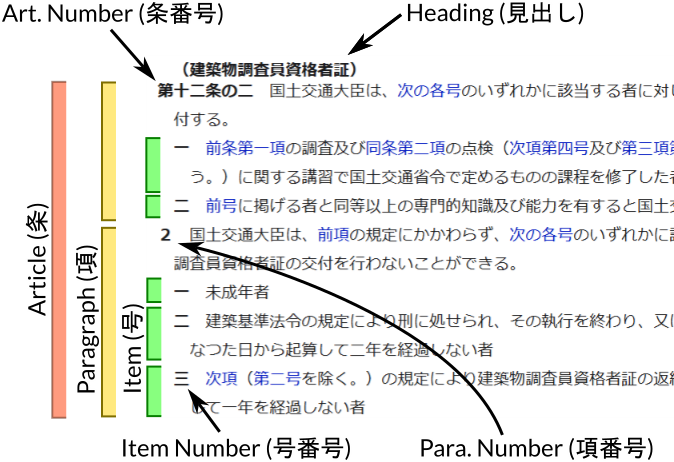
In Japanese laws and regulations, each provision is assigned an article number (条番号). In other words: each article (条) represents a single provision, or rule.
Some provisions entail complex considerations and conditions. As is necessary, articles are subdivided into paragraphs (項), each discussing an aspect or condition of the main provision. Each paragraph, except the first, has an assigned paragraph number (項番号).
If a paragraph has subcases that need to be listed, subdivisions called items (号 ) are provided. Items are assigned an item number (号番号).
Unlike paragraphs, the item number of the first time is always shown. This is because not all paragraphs have items. Think of items as a list of items, under a parent paragraph. Items are rarely provided without a parent paragraph (although this can happen). If there is no parent paragraph, the items are still treated as if they fell under the paragraph number following the order in that article.
It is possible, and common, to have subsequent, nested levels of subdivisions of items. Unlike articles, paragraphs, items, there is no name for the smaller units below “item”. They are simply called subdivisions of items (号の細分).
These subdivisions follow an established convention for outline numbering, however, which is discussed below.
In formally printed Japanese laws and orders, only kanji numbers (漢数字) are used. However, there is an accepted convention for less formal situations, e.g.: textbooks, periodical articles, research papers, study guides, etc.
It is very common that sometime after a law is enacted, it needs to be revised to meet new conditions or considerations. In many cases, new provisions must be added in inconvenient places, e.g., between two existing provisions.
The numbering system is part of the law and can only be modified by the rules that govern making and revising laws. This makes updating article, paragraph or item numbers very cumbersome, especially when considering that other separate laws and orders may references to affected numbered sections. This would require the Diet to revise the referencing laws as well.
In order to minimize the administrative burden, branch numbers (枝番号) are introduced. This system allows additions to be inserted between two existing passages, without needing to renumber all subsequent passages.
When a new passage is inserted between two existing passages, it receives a branch number. Branch numbers start with 2 and increase sequentially. In formal documents, the branch number written in kanji numbers after a の, which is suffixed on the previous passage number. In informal documents, the branch number is shown as an Arabic number with a preceding dash. See the example below.
NOTES:
In some cases, the Diet or other law-making entity may choose to renumber the provisions. This typically happens when there is a major overhaul to a law and it may make sense to clean up the numbering system. This has happened on occasion and does require that referencing laws also have to be amended.
Before the start of each article there is a heading (見出し), which is a title that summarizes the scope or purpose of the article. The heading is always provided in parenthesis. Also, the heading is part of the law and therefore has coercive force.
Generally, there is a heading before each article, but there are cases where articles don’t have a heading immediately before it. There two cases. The first, easiest is that the seemingly heading-less article actually shares a common headings (共通見出し) with one or more other articles. In this case the article without a heading actually falls under the most recent, previous heading.
In cases where an article does not have a heading and does not share a previous common heading, it’s usually clear from the context. In other words, the provision doesn’t require heading to create a scope or context.
In general, if there’s no heading, one can scan the previous text to find the last heading to see if it makes sense as a common heading. If not, the provision is likely a heading-less article.
Remember that an article marks a single rule but is actually collection of one or more paragraphs. A paragraph is formed from one or more sentences (文章), each a complete, independent statement. Each sentence ends with the Japanese period 「。」, also called a kuten (句点 ).
In a paragraph with more than one sentence, the first and last sentence are referred as 前段 and 後段. With three or more clauses, the middle clauses are referred to as 中段, etc.
These sentences (文章) combine to form a legal requirement or provision (条文). In a provision, the requirement always comes first, followed by any provisos (ただし書き). Provisos is a fancy word for “exceptions.”
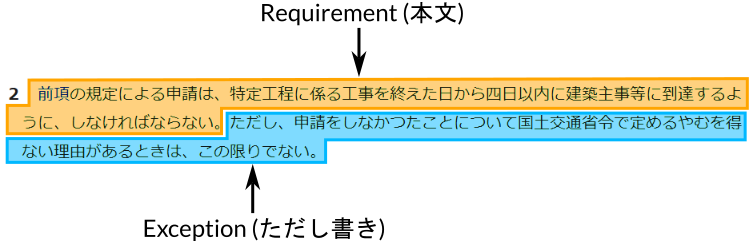
When a proviso is given, the preceding requirement sentences are the 本文 (lit. main provision) and the exception sentence is called the ただし書き. There are a few stock phrases used to indicates a proviso. Typically, the proviso statements begin with 「ただし、・・・」 (lit. “however,”), which is where the name ただし書き originates. Many times, the statement ends with such phrases as: 「・・・この限りでない。」 or 「・・・を要しない。」.
It is fairly common that there may be multiple proviso cases or conditions. While these can be listed inline in the paragraph, it is also common to see them listed as subordinate items. The ただし書き usually includes terms like いずれか (lit. "either" or "any") to indicate the sense of "if any one of the conditions apply, the proviso applies," otherwise, all the conditions must be met simultaneously for the proviso to apply.
Sometimes the text will refer back to the previous article (前条), rather than using the article number. Even more granular local references can be made: 前条2項, lit. “the second paragraph of the previous article.”
Don’t confuse this with 前段, which is the first sentence of a paragraph or item, etc.
XXX